The In-Between Hour: Stamps, Soup and the Midweek Lunch That Holds Winforton Together
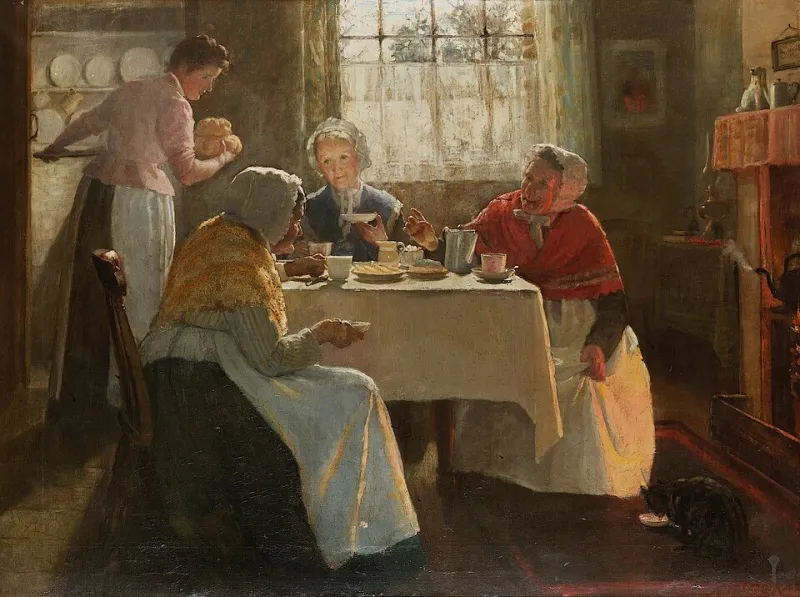
Photo: Mary Evelina Kindon (British, 1849 - 1919), Public domain, via Wikimedia Commons
Some lunches begin with a booking. Others begin with a parcel slip, a prescription, a bag of apples from the boot and the vague sense that if you are going to be out anyway, you may as well be out properly.
That is the errand-day lunch: the midweek meal that sits somewhere between the Post Office counter and the pint glass. It is not a celebration. It is not a treat in the usual sense. It is a pause — a small, civilised interval in a day that was already doing several other things. And at The Sun Inn, it has become one of the truest measures of what the pub is for.
A Village Timetable With Gravy
Winforton does not run to a city timetable. Things happen in their own order. The school run has its moment, the delivery van has another, and the noticeboard outside shifts its paper around with the weather. On a grey Tuesday in November, the village day is made of small errands, and each one seems to lead, quite naturally, towards lunchtime.
You see it in the doorway: a coat with a bit of rain on it, a canvas bag with a loaf in it, a folded letter that has just been stamped. Nobody arrives pretending they have come for a grand occasion. They have come because the morning has been useful and the middle of the day is now asking for something warm.
That is not a small thing. In 2026, village life is still a patchwork of practical journeys — the pharmacy, the shop, the parcel drop, the library van, the butcher, the friend who needs a lift. The pub works best when it sits inside that patchwork rather than apart from it. It is not the destination at the end of a long drive. It is the room where the day can briefly put its bags down.
Two Speeds, One Kitchen
The mistake is to think the errand-day lunch has to be either fast or fancy. In practice, it is often both at once. One table needs to be back out in twenty minutes. Another has nowhere else to be until three. The kitchen has to understand that these are not opposite customers. They are the same village on different afternoons.
That is why the menu works in two gears. There is the quick bowl — soup with bread, a sandwich with something sharp and crunchy alongside it, a small plate that lands hot and does not demand a ceremony. And there is the slower plate — the pie, the potatoes, the greens, the gravy that needs a spoon and a bit of respect. Neither is the lesser option. A bowl of soup eaten in a hurry is still a proper lunch if it has been made properly. A long lunch on a Wednesday is not indulgence if it is the only quiet hour you have had all week.
The Quick Bowl and the Slower Plate
The quick lunch is not a compromise. It is a contract. You sit down, you get something hot, you are not made to feel that you have failed to enjoy yourself because you have a car parked outside and a list in your pocket. A bowl of soup and half a sandwich is enough. A small plate and a glass of something low-alcohol is enough. The point is not to stretch the meal. The point is to make the pause count.
The slower plate is the same idea in another key. It says that errands do not have to be the enemy of pleasure. You can drop the bags by the chair, order a pie, and let the afternoon take a little longer to arrive. You can have pudding because the rain is still coming down. You can have coffee because the conversation is not finished. The kitchen does not need to know whether you are early or late. It only needs to cook as though both are worth doing well.
Why Midweek Matters
Weekend trade is easy to understand. It is loud, planned, and often full of people who have driven some distance to be there. Midweek trade is different. It is quieter and more revealing. It tells you whether a pub is woven into the ordinary life of a place or merely polished up for the days when everyone has time off.
A pub that only works on a Saturday is a venue. A pub that works on a Tuesday is a pub. The errand-day lunch is a good test of that because it asks for something modest and practical: a table, a warm plate, a bit of recognition. It does not ask for a performance. It asks for consistency.
And consistency is what countryside hospitality is really made of. Not the grand gesture, but the fact that the soup is on when the weather turns, that the bread is fresh, that the person behind the bar knows you may only have half an hour and still says hello properly. That is not a small detail. It is the whole point.
The Table Between
The best table at The Sun Inn is not really a table at all. It is the hour between one thing and the next — between the stamp and the school pick-up, between the parcel and the pint, between the version of the day that is all jobs and the version that remembers to feed you.
So bring the bag. Bring the wet coat. Bring the list you are halfway through. Sit by the window and have the soup, or take your time with the pie. The errand-day lunch does not need a name on a board or a special occasion attached to it. It just needs a pub that is open, a kitchen that is ready, and a village that still understands the value of stopping for an hour.