The Imperfect Apple: A Winforton Cider Story That Begins on the Ground
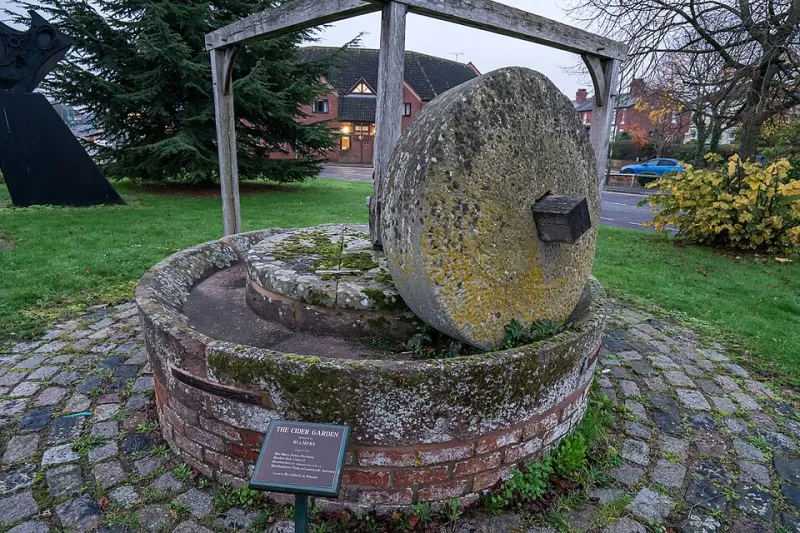
Photo: Brian Deegan , CC BY-SA 2.0, via Wikimedia Commons
There is a particular smell to a pub yard in late autumn. It is wet leaves, cold stone and apples going slightly sweet at the edges. By the time the crates are stacked against the wall at The Sun Inn, the cider season is already well under way — not with a grand harvest, but with a series of small deliveries from gardens around Winforton.
A bag here, a boot-load there. Someone’s Bramley tree has done what Bramley trees do and produced more than any one household can reasonably eat, cook, freeze or palm off on neighbours. Someone else has a few eaters that have gone soft on the ground. None of it is supermarket-perfect. All of it is useful.
It Starts With a Knock at the Door
The house cider we pour is not made from fruit bought by the tonne from an anonymous supplier. It is made from what the parish and the lanes around it can spare. That sounds romantic until you are the one sorting through a crate and finding a wasp, a leaf and an apple that has clearly been thinking about becoming compost since September.
Still, that is the job. The fruit gets checked, washed and cut away from the worst of itself. Bruised apples are not a problem. Rotten ones are. The difference matters, and it is the sort of judgement you learn by doing rather than reading. A little damage is fine. A lot of damage will follow you all the way through fermentation and into the glass.
This is the first argument for community-scale cider. You know where the fruit came from because you probably know the person who dropped it off. You know the garden, the tree, the weather it endured and the fact that the grower will ask about it in the pub in February.
The Borrowed Crusher and the Honest Mess
We do not have a gleaming cider works. We have a borrowed press, a scratter that earns its keep, plenty of buckets and a willingness to get sticky. The process is simple enough: mill the fruit, press it, collect the juice, clean everything, repeat until the light goes or the apples run out.
The mess is part of it. Pulp gets everywhere. Juice runs down the side of the press. Someone always forgets that a full bucket is heavier than it looks. But there is a rhythm to it too — the whirr of the scratter, the creak of the press, the dull thump of apple pulp going into the cloth. It is not glamorous. It is, however, deeply satisfying in the way that any proper November job can be.
What comes off the press is cloudy, sharp and alive. Sometimes it is sweet. Sometimes it makes your cheeks ache. That variation is not a flaw to be corrected with a bag of sugar and a label. It is the whole point. A blend of local apples gives you a drink with a bit of weather in it.
Fermentation Is Mostly Waiting
Once the juice is in the vessel, the hard work becomes patience. Fermentation does its own thing, more or less. You keep an eye on it. You keep things clean. You resist the urge to interfere too much. Then you wait.
The first few weeks are lively. After that, the cider settles into a slower mood. It clears, or doesn’t. It sharpens, softens, changes its mind. This is where small-scale cider can feel less like manufacturing and more like keeping an eye on something living. And it is why the house cider changes from year to year — the 2026 pressing will not taste exactly like the one before it, because the apples did not have exactly the same summer.
That is not a marketing line. It is just how it works. A supermarket bottle is built to taste the same every time you buy it. A community cider is built to taste like the place and the season that made it. Both have their merits. Only one of them can tell you which garden the fruit came from.
Blending Is Where the Pub Steps In
When the cider is ready, the blending begins. Some barrels or vessels are sharper, some fuller, some quieter. The aim is not to flatten those differences but to bring them into balance. A little of the brisk fruit, a little of the rounder stuff, a little of whatever the year has given us.
At The Sun Inn, that blend has to do a particular job. It has to be good on its own, at the bar, after a walk. It also has to sit beside food without shouting over it. House cider works best when it is confident but not loud — dry enough to cut through a plate of pork, gentle enough to sip while you wait for a friend.
What We Pour It With
Cider and food is not a complicated pairing. It is mostly about matching weight and freshness. A dry, appley cider is excellent with roast pork and crackling, where the acidity lifts the richness. It works with a proper ploughman’s — mature cheddar, pickled onion, good bread and butter. It is very happy beside a sausage roll, especially if there is apple or sage involved. And it can hold its own with a bowl of chips, which is as good a test as any.
On the sweeter side of things, a glass of cider and a slice of apple cake is not subtle, but it is right. The same applies to a crumble, or a wedge of slightly sharp cheese at the end of a lunch. These are not pairings designed to impress a tasting panel. They are pairings designed for a table by the window when the light is going at four o’clock.
Why the Anonymous Bottle Falls Short
The supermarket cider aisle is a marvel of consistency. It is also strangely forgettable. The bottles are cold, the labels are clean, and nothing about them asks you to think about the tree, the garden or the people who picked up the windfalls. That is not a crime. Sometimes you just want a drink.
But there is a different pleasure in drinking something made at a scale where the word ‘vintage’ means something. Our house cider has a postcode. It has a year. It has a story that begins with someone knocking on the pub door with a bag of apples and asking if they are still wanted.
A Vintage With a Postcode
By the time the cider reaches the bar, the apples are long gone. What is left is a drink that tastes of Herefordshire in a particular year — sharp, rustic, sometimes a little unruly. It will not be identical next season. That is the deal.
So if you see the crates in the yard, or hear the press groaning somewhere behind the pub, that is the sound of the next glass being made. Windfalls, pulp, patience and a bit of help from the neighbours. It is a slow way to make a drink. It is also the only way to make one that belongs here.