Knife Down, Glass Half Full: The Case for a Lunch That Takes Its Time
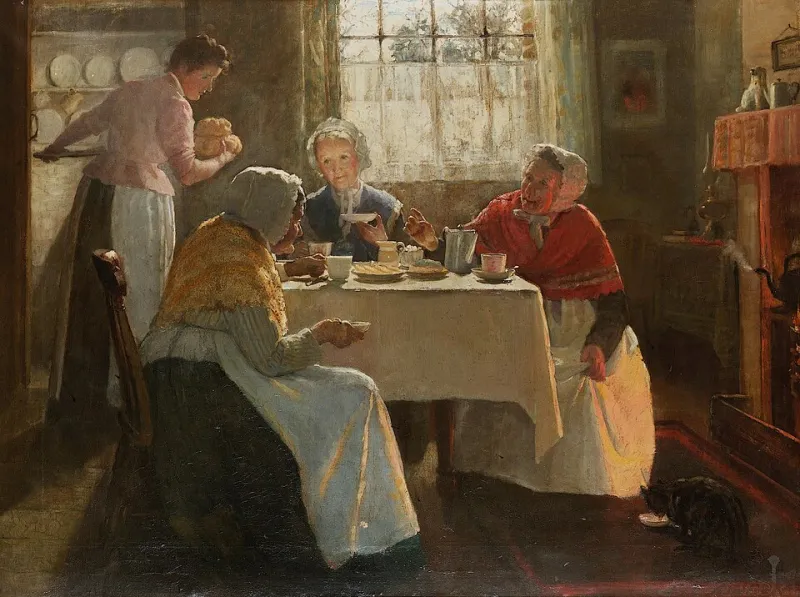
Photo: Mary Evelina Kindon (British, 1849 - 1919), Public domain, via Wikimedia Commons
There is a particular kind of lunch that belongs in a country pub. It starts with a pint that has time to settle, a menu that takes a minute to read, and a plate that arrives when it is ready rather than when a timer says so. At The Sun Inn, we are not against speed. We are against rushing a meal that was never meant to be fast.
A proper pub lunch is one of the last places where you can sit down without a laptop, order something cooked to order, and let the afternoon take its own shape. That is not an accident. It is a service decision.
A Lunch, Not a Lap
Fast food has its place. A motorway services sandwich, a station coffee, a bowl of something before a train from Hereford — all fine. But a lunch in Winforton is not that. Our kitchen is not a vending machine with a chalkboard. The pie needs time in the oven. The chips need their first fry, a rest, and their second. The gravy needs to be gravy, not a gesture.
When we talk about pacing, we do not mean making people wait for the sake of it. We mean giving a table enough room to order a starter if they fancy one, to share a bowl of olives, to ask what the guest ale is like, and to change their mind about pudding. A lunch that is over in twenty-five minutes can be a perfectly good lunch. It just is not the only good lunch.
There is a useful rule of thumb in the trade: aim for the first proper mouthful within about twenty minutes of sitting down, not twenty minutes from walking through the door to paying the bill. That first mouthful might be bread and butter, a bowl of soup, or a few chips from a starter. It tells the table that things are moving. After that, the meal can breathe.
What Pacing Actually Looks Like
From the guest side, good pacing is almost invisible. Drinks arrive. The order is taken without a performance. The starter lands, then a gap that feels deliberate rather than forgotten. The main course follows when the table is ready for it, not while someone is still finishing the last of the croquettes.
From our side, it is a series of small checks. The bar knows which tables have ordered and which are still deciding. The kitchen knows which tickets are starters and which are mains. The front of house knows that the couple by the window are celebrating something and the four on the middle table are on a walking schedule. We are not reading minds. We are paying attention.
That is why we ask questions at booking. Not to be nosy. If you have a table at twelve and a train at half one, that is useful information. If you are bringing a toddler who turns into a pumpkin at two, tell us. If you have booked for a long lunch and want to work through the menu slowly, tell us that too. The kitchen can cook the same food for both tables. It cannot guess which one you are.
If You Are on a Clock, Say So
There is no shame in a tight timetable. Country pubs are not monasteries. People have buses to catch, dogs to walk before dark, and meetings that start in Hay at three. The trick is to say it early, ideally when you book or when you sit down.
A simple line works: ‘We have about an hour.’ That does not mean we will throw a plate at you. It means we will steer you towards the dishes that can move a little faster, take your drinks order promptly, and bring the bill without making you hunt for it. It also means the kitchen will not put your order behind a table of eight who have just ordered three courses.
What does not work is ordering a slow-cooked dish and then checking your watch every four minutes. We understand the impulse. But a braised beef cheek cannot be hurried any more than a cask ale can be poured clear in ten seconds. If time is short, let us help you choose.
The Table Sets the Pace
The other side of the bargain is that a slower table is usually a better table. Not because slow is automatically good, but because a relaxed lunch gives everyone room to do their job properly. The kitchen can season, rest and plate without cutting corners. The bar can pour a proper pint rather than a hasty one. The guest can taste what is in front of them instead of eating it as a task.
It also makes for a nicer room. A pub full of people who are not checking their watches is a pub that sounds like itself: cutlery, low conversation, a dog sighing under a table, the occasional laugh from the bar. That atmosphere is not a side effect. It is part of what you came for.
The Last Coffee
We like a lunch that ends with a coffee rather than a receipt slapped down at the elbow. If you want to sit for ten minutes after the plates are cleared, that is not a problem. If you want a second pot, ask. If you want to pay at the bar on the way out, that is fine too.
The point is not to make lunch last forever. The point is to let it take the time it needs. A proper pub lunch should feel like an afternoon in Winforton, not a race to the car park. We will pace the kitchen and the bar. You bring the appetite and, if you have one, the timetable. We will meet you in the middle.